

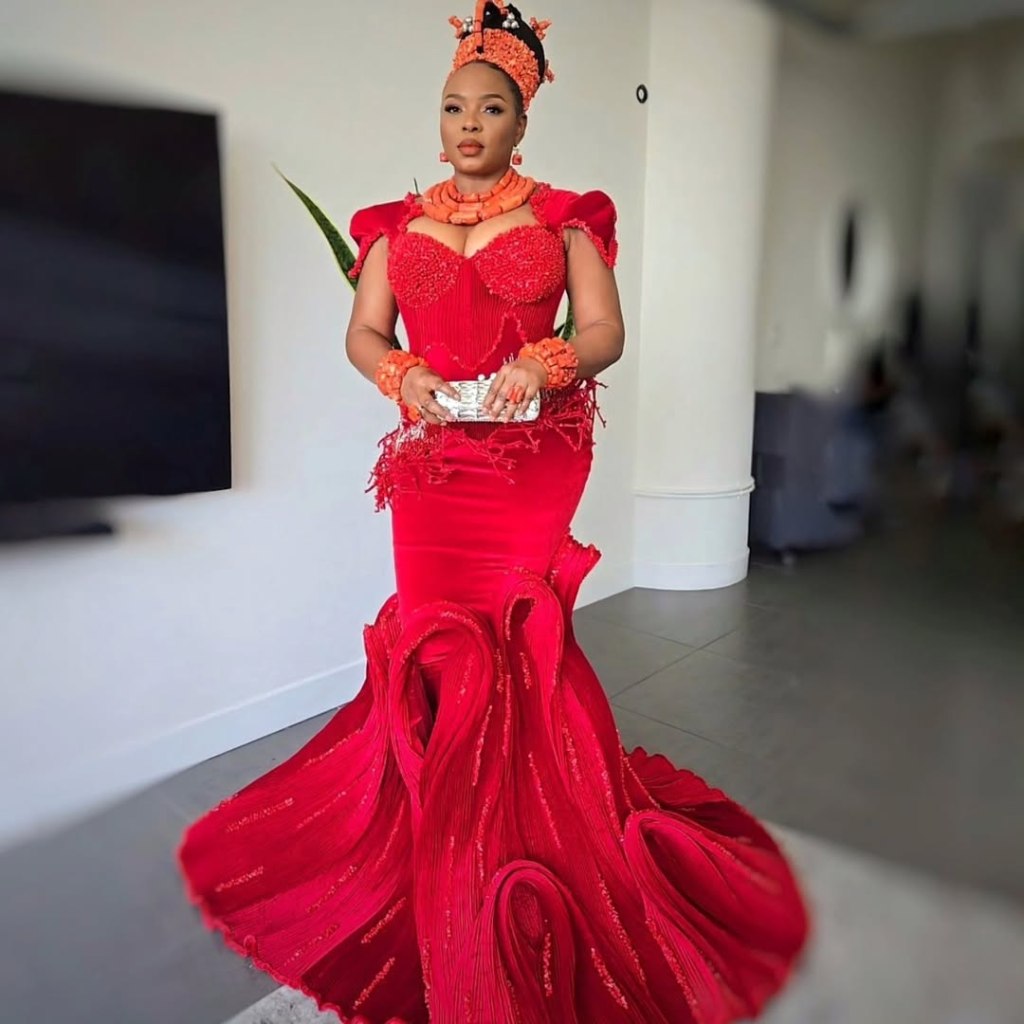
In an NPR interview, Yemi Alade described herself as a vessel for culture, effortlessly connecting with languages—even those she doesn’t fully understand. Throughout her career, she has proudly represented Africa through both her music and fashion, and the 2025 Grammy Awards were no exception.
Nominated for Best African Music Performance for her single Tomorrow, Alade arrived in a striking red ensemble and a headpiece inspired by Edo bridal attire. While many praised her bold cultural statement, others ignited debate. Some felt the outfit was too culturally specific for the Grammys, while others questioned whether it was appropriate given a recent royal directive. On January 25, 2025, the Oba of Benin Palace publicly condemned the indiscriminate use of sacred Edo symbols like the Ikele, Eben, and Okuku—the headpiece Alade wore. However, netizens countered that her headgear was not the royal Okuku worn by Benin queens but a more common variation, making it technically acceptable.
This debate extends beyond Alade’s outfit, raising a larger question: Should Nigerians wear attire outside their heritage?
Cultural representation requires nuance. While Alade’s passion for showcasing African identity on a global stage is clear, her Yoruba (Ondo) and Igbo (Abia) lineage complicate the situation. Since her goal was to represent Nigeria, attire from one of her cultures would have been more appropriate.
In a conversation with Culture Custodian, Cameroonian designer Dongio Jiotsa Eugene Casil (Djec Fashion), who collaborated on Alade’s look, addressed the discourse noting “Our vision was to represent Africa as a whole, not to focus on being Edo or Ondo.”
On a broader level, Nigerians frequently embrace attire from other cultures, a practice generally accepted—so long as the originating culture has no objections. However, this cultural fluidity has its limits, particularly given Nigeria’s complex ethnic landscape. Despite shared histories and cultural intersections, Nigeria’s ethnic diversity isn’t a homogeneous blend where all cultural elements carry equal weight or meaning. The relationship between dominant ethnic groups and minority communities remains a sensitive fault line in Nigerian society, with ongoing discussions about representation, respect, and power dynamics.
This context makes Alade’s choice particularly complex. As someone of Yoruba and Igbo heritage—both historically dominant ethnic groups—wearing Edo regalia as a costume on music’s biggest global stage raises questions about privilege and cultural sensitivity. Without a clear contextual connection to Edo culture or a deeper artistic statement being made, the choice could be seen as reinforcing problematic patterns of cultural appropriation within Nigeria itself.
This complexity has extended beyond Nigeria’s borders, with foreigners increasingly adopting traditional Nigerian wear. In recent years, Black and white Americans have been spotted wearing Yoruba aso-ebi and owambe attire for events with no cultural connection to Nigeria. Some view this as global appreciation, while others argue it strips the garments of their deeper significance, turning them into fashion statements rather than cultural symbols.
So, where do we draw the line between cultural appreciation and appropriation? The distinction often comes down to context, intent, and consent. Appreciation occurs when cultural symbols are worn with respect and understanding. Appropriation happens when they are borrowed without credit, knowledge, or consideration—especially when the originating culture expresses discomfort.
For Yemi Alade, her Mama Africa persona has long positioned her as a champion of African culture, and her intentions were undoubtedly sincere. But sincerity doesn’t erase the complexities at play. Yet, because of Alade’s track record in cultural advocacy, many are willing to extend her grace. Her years of authentically representing Africa lend credibility to her artistic choices. Rather than condemnation, this moment invites dialogue—a necessary conversation about cultural respect, representation, and the delicate boundaries of artistic expression in a globalized world.
