

Nigeria’s tenuous relationship with values has dominated public discourse for much of our 66-year history. It’s not unlike what’s obtainable in other countries, given that nation-building is a continuum and generalisation does not account for diversity of ideology. Our value discourse just happens to have devolved drastically in recent times, coalescing in moments when satire fails to capture the absurdity of what we hold dear.
On March 17, 2026, the Benin Traditional Council issued a statement prospectively banning popular streamer and social media influencer, Habeeb Hamzat ‘Peller’ Adelaja from the Oba of Benin’s Palace, for ‘gaining unauthorised access to the palace premises’ on March 6, 2026, and engaging in disruptive conduct that ‘caused a significant breach of the peace within the palace grounds.’ The statement further included that a staff member, one Mr Omuemu, had been detained by the Nigerian Police Force for abetting the unauthorised entry, with a Queen ‘facing disciplinary proceedings.’ The Queen could potentially also be removed from the palace.
Additionally, the statement signed by Benin Traditional Council Secretary Frank Irabor, reveals that Peller was invited before a panel of Chiefs to explain his actions, but failed to appear. The Council then issued a formal demand that the streamer present himself and tender an unreserved written apology; failure to do so will result in legal action.
Individuals familiar with Peller and the chaotic carry-ons of Nigeria’s livestreaming subsector will hardly be surprised by this news. It’s not the first of its sort, nor does it look set to be the last of these indecorous public displays. A day earlier, a Lagos resident, Osarobo Odigie, reportedly filed a 395 million Naira lawsuit against the streamer for defamation, cyber harassment, and invasion of privacy arising from a January 6 incident. The suit claims that Peller had verbally abused her and recorded her without consent over a dispute, with the subsequent viral video leading to defamatory statements against her person. Earlier in February, he and fellow streamer Carter Efe damaged each other’s cars while livestreaming. In December 2025, Peller crashed his car on account of an alleged ‘breakup’ with his girlfriend, internet personality, Jarvis.
Someone with such a history of controversies shouldn’t possibly have anything to do with a prestigious institution like the Benin Palace. Benin City was merely to be the first of sixteen stops on his self-proclaimed nationwide tour announced on March 4, 2026—undoubtedly influenced by American streamer IShowSpeed’s 20-nation Africa tour from December 29, 2025, to January 26, this year. Vapid viral clips from Speed’s visit to Nigeria portrayed our value system in such a negative light that any well-meaning streamer aware of their inadequacies should have steered clear of this outcome entirely. Not Peller, evidently.
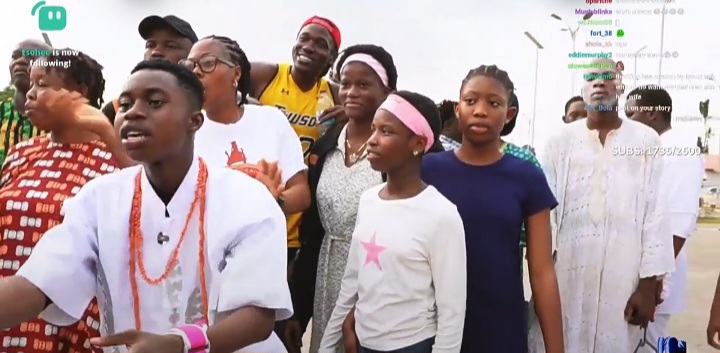
Even before arriving at the Oba’s Palace, the influencer and his entourage had initiated rancour with their actions. Peller’s 7-hour 22-minute Benin City Kick stream began at the Benin City Airport, with a statement that his manager had been imprisoned and that his bouncer had injured some other individual. Barely 10 minutes in, he rambled uncouthly about taking a dump at the Palace (“When I get to the Palace, I’ll ask for the Visitor’s room and put it there). It got worse. A group of traditional dancers presented him with the white shirt and flowing ‘skirt’ typically worn by Edo men, beads, and a local gong—a reverse take on the “My culture is not your costume” aphorism. As he left the airport, throngs of youth encircled his vehicle, dispersing only after he shared 200 Naira notes.
To say that the rest of the livestream was pleasant would be untrue. Youth lined the roads leading to the palace, making his entrance a hassle. Older men and women joined in at some point, struggling to be captured on film. Online, comments poured in droves. Palace officials had to demand order from his entourage, as they dramatically reacted to the arrival of some of the younger royals. The only redeeming portion of these interactions was one of Peller’s team members explaining the purpose of the visit as a recognition of the Oba’s prestige. In return, two chiefs educated them about colonial and post-colonial history. After about an hour of streaming, one of the queens arrived and presented the influencer with gifts, bringing an end to the palace section of the tour.
If you look away from the fact that an entire hour of so-called content in one of the country’s most important heritage sites amounted to just a few minutes of relevant knowledge, there’s no issue with the stream. But if you sit down with the fact that, to the hundreds of men and women who welcomed Peller and followed him all the way to the palace, he represents a celebrity worth aspiring to, the issues emerge. Benin City is meant to be one of the country’s most vibrant cities. It’s a repository of centuries of culture and tradition. Yet, when it comes down to it, those values mean nothing.
Call it preaching, or morality mongering, all you want, but this is a worrying sight. At least, with reality television, there’s an assurance of scripting. A livestream of this nature reveals the cold, hard truth. Culture is a costume on sale to whoever can afford it. Never mind that said buyers are terrible ambassadors for the values we profess as a people.
The Benin Traditional Council definitely took all of this into account in their decision-making. In the years since he emerged as ruler of the Benin Kingdom, His Royal Majesty, Omo N’Oba N’Edo, Uku Akpolokpolo, Ewuare II, the Oba of Benin, has taken extra measures to preserve his people’s regality and prestige. Most recently, in late 2025, this took the form of public statements renaming the Museum of West African Art (MOWAA) as the Benin Royal Museum—arguably misplaced actions that point to a reverence for Edo tradition. To then visit the cradle of this closely-guarded culture without due regard for what they stand for, or even pretend to care well enough, just shows a sense of aloofness that should not be encouraged.
It’s easy to paint Peller’s actions as a standalone effect and appropriate blame for this wave of thoughtless content solely to himself and colleagues like Carter Efe, Geh Geh and Shank Comics. This shortsighted approach only shields consumers from critique, preventing us from asking more pertinent questions: Why do these vacuous livestreamers have a platform? Why have they sustained prominence?
All of the answers, whether linked to the economy, foreign influence, or abstractions like moral apathy, lead us back to values. Our value system is broken. Because it is broken, what we regard and disregard rests on fragile biases. That’s why images of a woman in avant-garde newspaper headgear would trigger a tribal war over geles and ichafu, why Nigerians would wrongly attribute other African practices to their tribes or dispute racism felt by the Black diaspora. Why, in the case of MOWAA, we’d willingly destroy millions of Naira worth of investments for politics. Why young people care more about the amount of money Peller makes and the Obi Cubanas he rubs shoulders with at events than the emptiness of his streams. Our value system is too fractured along the lines of status and difference, with depth largely forgotten. We are drawn to bottom barrel content that’s ‘funny,’ but against traditional ideology. These are the issues.
Didactic sentences here won’t suddenly provide our catch-all solution. Perhaps, this is reductive as a reading of the value problem. Nevertheless, it is important to reflect on whom and what we give a platform to. Consider that the Benin Traditional Council’s long-term response to the events of March 6th was to introduce new rules governing access to the site, and IMT University, Enugu, denied the streamer entry for failing to inform the management in advance. On the other hand, Peller took to TikTok Live to announce the tour’s suspension, claiming that ‘people don’t like him’ and he’ll just ‘go to two Yoruba states’. No lessons learned. No regard acquired. Just one more recalcitrant streamer waiting for the next “Ws in the chat.”
