

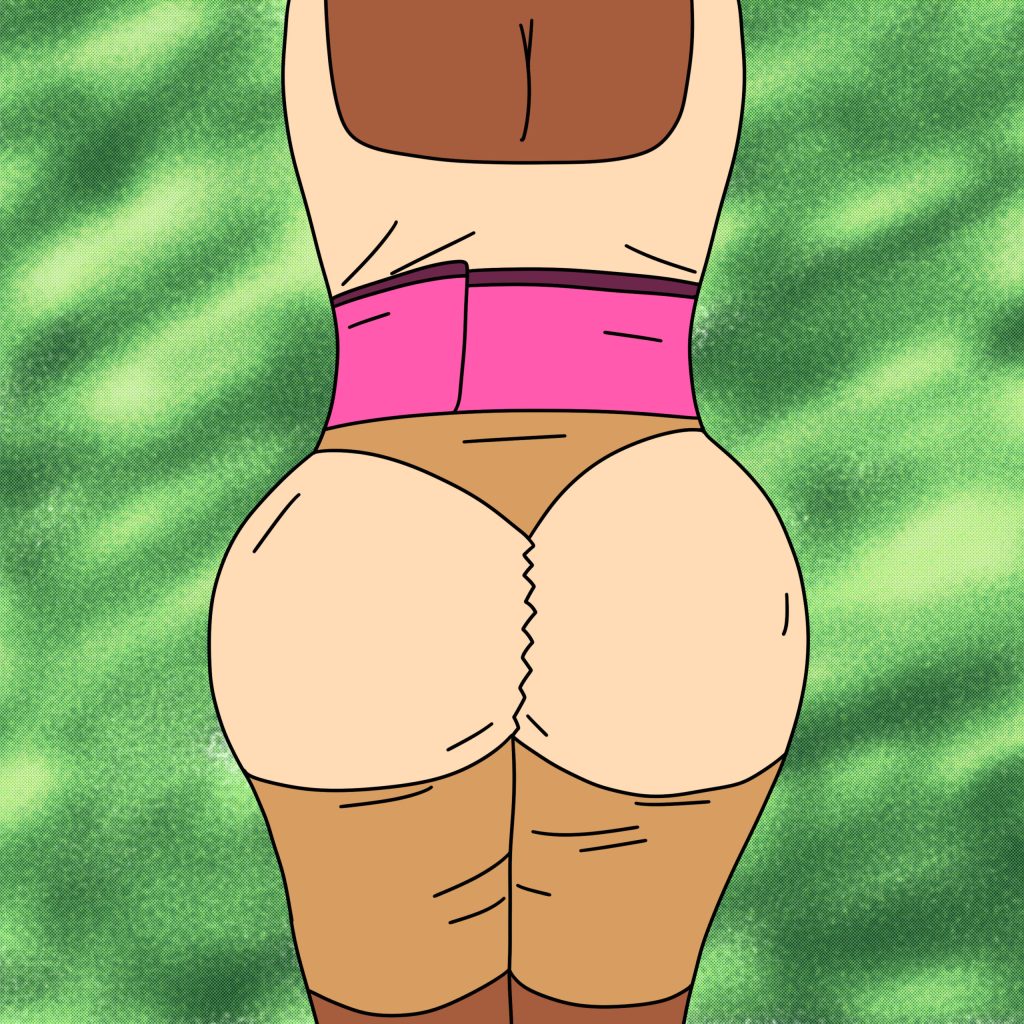
The news of Elena’s death took over the internet, generating dozens of comments and reactions. The influencer had gone in for a Brazilian Butt Lift (BBL) procedure and never made it out. A constant refrain during the dirge was the question, why did she go for a second BBL? It was public information that she went under the knife. A stark shift from the boom days when the surgery was only carried by whispers. This visibility matters because it shows how cosmetic procedures, once private and risky, have become normalised and even celebrated online, while the real dangers are often overlooked. And this turn is anything but cancerous.
BBLs have existed long before its roaring 2010 days. The procedure was first performed in 1960 when plastic surgeons experimented with fat transfer. For decades, it was a niche and rare technique. accessible mostly to wealthy clients and high-profile figures, including celebrities and adult film stars, who could afford the steep costs, often ranging from thousands to tens of thousands of dollars, and travel to specialised clinics. At the time, success rates were unpredictable, and the surgery carried serious risks, including fat embolisms and other complications, making it a high-stakes procedure rather than a casual beauty choice.
Then came the 2010s. BBL surgeries worldwide increased to 77.6% in just a few years. Global pop culture was becoming “revolutionised” as black beauty aesthetics—curvy bodies—began entering mainstream consciousness. Celebrities like Kim Kardashian, Nicki Minaj, and Cardi B popularised exaggerated curves.
At its early surge, the surgery was spoken about in hushed tones. People gave out private surgeon recommendations. Rumours trailed them, but there were no confirmations. If the BBL recipients were probed too much, they attributed their curves to diet, gym or genetics.
In Nigeria, cosmetic procedures were often shrouded in secrecy for both social and cultural reasons. The late Stella Obasanjo’s alleged complications following a tummy tuck exemplify the risks and stigma associated with going under the knife. At the time, women who pursued surgery were often shunned or quietly judged, and discussions about such procedures—especially when linked to health consequences—rarely entered public discourse. This conservative cultural posture meant that cosmetic surgery existed behind closed doors, making today’s brazen openness around BBLs a clear-cut departure from the past.
But today, the surgery is more proliferated and dominates many conversations about the female body. In August last year, Instagram-famous Victoire Mahounou vlogged her BBL experience from the announcement to the surgery and recovery. Mahounou took it a step further by selling ebooks containing a documentation of her experience. Another content creator known in the HR space, Adeife, followed suit months later. The undertones of both women’s vlogs were honesty, liberation, and empowerment.
The common argument in favour of this honesty was the removal of stigma around cosmetic surgery and the encouragement of women to own their choices. But cosmetic procedures are rarely ever purely personal choices. Beauty standards have always operated within patriarchal expectations of women’s bodies. In “Male Gaze,” Laura Mulvey dissects how visual culture, films, ads, and social media frame women’s bodies from a male point of view, often objectifying them.
Beauty standards are designed for the male eye, to appease their desires. This explains why certain features are emphasized: curves, skin tone, proportions, or facial symmetry. Within this context, women’s bodies could be likened to those of show animals; meant to be looked at and admired. And because male desires and cultural trends are not set in stone, what is considered beautiful evolves over time. This is exhibited in historical patterns. In the Victorian era, pale, fragile women were the ideal. The 1920s brought about the boyish, thin silhouettes. Twiggy-style waif permeated the 1960s. The hourglass figure itself, however, has never truly disappeared; it has resurfaced at different points in time, from the corseted Victorian body to the curvaceous ideals of the 1950s. What we are witnessing now is not a new standard but a resurgence of that same ideal, with BBLs emerging as a modern method of achieving it. The male gaze mingles with media and social norms, constantly redefining what bodies are ideal. Thus, beauty standards arise as a set of laid-down rules for how women must look to earn the desire of men
The argument of choice is a perforated one, as it is simply an illusion. Freedom of choice is the ability to make decisions without being forced or unduly pressured by others. Women are constantly influenced by the male gaze, media portrayals, and cultural ideals of desirability. Social media, celebrity culture, and peer comparison create an invisible conveyor belt, signaling what bodies are “acceptable,” “aspirational,” or “desired.” Even when women feel they are asserting autonomy, they are often responding to these pressures. When beauty standards inevitably shift again to skinny, many women would be scrambling to take their BBLs out.
The seeming transparency these influencers are offering is an advertisement for a surgery wherein 1 in 3000 patients dies during the process. Plastic surgery societies have termed it one of the deadliest of cosmetic surgeries. In Nigeria, however, the danger is compounded by the healthcare system itself. Many clinics operate without proper accreditation, and there is a severe shortage of qualified cosmetic surgeons, leaving procedures in the hands of undertrained or misrepresenting practitioners. Seemingly routine surgeries that may be relatively safe elsewhere can fail catastrophically here. Reports have highlighted cases of women in Lagos nearly dying after BBLs performed by nurses or unlicensed personnel posing as surgeons, sometimes requiring millions of naira in emergency care. At the same time, the rise of unregulated clinics and lax oversight has allowed this dangerous industry to grow alongside social media visibility and aspirational narratives.
This visibility tampers with how people perceive cosmetic surgery. What was once seen as a serious medical intervention now appears to be routine, achievable, and aspirational. With this normalization comes the rise of the BBL industry in Nigeria, specifically Lagos, the economic powerhouse of the country.
As of October 15 2025, Smartscrapers recorded a total number of 13 plastic surgery hospitals in Lagos. An 8.33% increase from 2023. They are also establishing a digital presence across various platforms. Four have LinkedIn profiles, nine maintain Facebook pages, eight are active on Instagram, five have X (formerly Twitter) accounts, one is on TikTok, and two run YouTube channels. The procedure has grown into a recognizable beauty standard. Procedures range from N2 million to N20 million. It is no mistake that the new BBL craze arrives at a time when Nigeria’s economy is being plunged into the depths of hell, with about 60%-62% of the country’s population living below the national poverty line.
In The Theory of the Leisure Class, Thorstein Veblen argues that people often buy things not because they need them but to signal class. Referred to as conspicuous consumption, it is the act of publicly displaying wealth to prove you belong to a higher class. He also suggests that when economic inequality grows, people become obsessed with visible signs of wealth. This is because wealth differences become more vivid. Comparisons to the upper class are made by the lower class. And everyone tries to be like the class just above them. Sociologists call this status consumption, marking social positions using visible goods.
A status ladder is created. The upper class sets the standard, the middle class imitates them, and the lower class emulates the middle. Status symbols are designed to be read off billboards. Status symbols signal social positions publicly. A N7 million BBL says “I belong to a higher class” “I’m richer than you.” “I’m not one of you.” It signals access to money. In a struggling economy, BBL bodies become social markers.
While this new outspokenness attached to BBLs seems like liberation and empowerment, it is not. Liberation sets you free, BBLs keep you tethered to ever-evolving beauty standards. The beauty industry is built on the anxiety and insecurities of women. Liberation for the industry is its Armageddon as beauty standards are a form of social control. That is why Naomi Wolf argues in The Beauty Myth, that the intensity of beauty standards attained new heights in the late 20th century when women began asserting more social power. Wolf states clearly in her thesis, “As women released themselves from the feminine mystique of domesticity, the beauty myth took over its lost ground, expanding as it went to carry on the work of social control”.
For the beauty industry—an industry largely dominated by men—to thrive, beauty standards must keep shifting. If the standards are within reach, women will cross the finish line, and that control will be lost. So, the striving must always be in motion.
It is not empowerment, we are simply continuing the atilogwu to the beats of patriarchal definitions of beauty. The only difference is that we are doing it publicly and brazenly.
